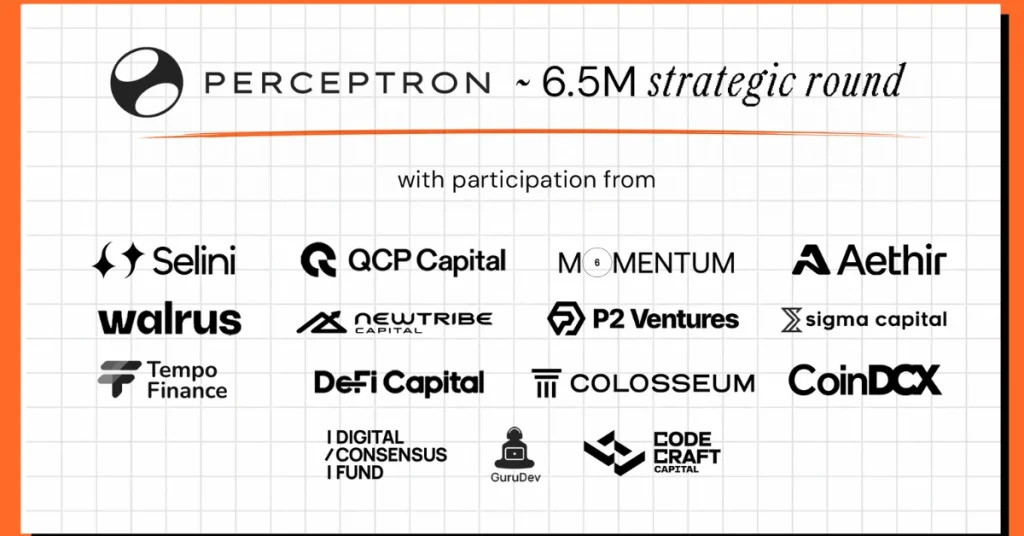
Perceptron, a pioneering decentralized AI data network, has announced the successful close of a $6.5 million strategic funding round. This significant capital injection, secured from a diverse group of leading Web3 investors, trading firms, ecosystem partners, and infrastructure leaders, marks a pivotal moment in the rapidly evolving landscape where artificial intelligence intersects with decentralized technologies. The funding, disclosed on July 30th, 2026, is earmarked to accelerate the development and deployment of a crucial infrastructure layer designed to power the next generation of AI applications with unprecedented transparency, security, and scalability. As a Senior Crypto Analyst, I view this investment not merely as a financial transaction, but as a resounding vote of confidence in the transformative potential of decentralized AI, signaling a clear trajectory towards a more open, equitable, and innovation-driven future for intelligent systems. The implications extend far beyond Perceptron itself, pointing towards a structural shift in how data-intensive AI models will be built and governed, challenging established paradigms of centralized control and ushering in an era of verifiable, community-owned AI infrastructure.
The Confluence of Two Titans: AI and Web3
The past decade has seen artificial intelligence emerge as the most impactful technological force, reshaping industries from healthcare to finance. Its unprecedented capabilities are fueled by an insatiable appetite for data. However, this reliance has simultaneously highlighted significant vulnerabilities: pervasive data centralization, escalating privacy concerns, the potential for embedded biases, and the monopolization of critical data resources by a select few tech giants. Large, proprietary datasets often lead to opaque AI models, raising profound ethical questions, hindering explainability, and stifling innovation for smaller, independent developers and researchers who lack access to such vast resources.
Enter Web3, a paradigm built on the foundational principles of decentralization, transparency, and user ownership. Blockchain technology, with its immutable ledgers, cryptographic security, and token-based incentive mechanisms, offers a compelling antidote to many of AI's current woes. By decentralizing data storage, access, and governance, Web3 promises to unlock new possibilities for AI development, fostering an environment where data providers are fairly compensated for their contributions, individual privacy is paramount through advanced cryptographic techniques, and AI models can be trained on more diverse, verifiable, and unbiased datasets. The fusion of these two titans — the unparalleled intelligence of AI and the integrity and openness of Web3 — is not just a technological marriage of convenience; it represents a fundamental re-architecting of how AI will be built, used, and governed, moving towards a more robust, resilient, and democratic framework.
Perceptron's Vision: Decentralizing the AI Data Backbone
At the heart of Perceptron's mission is the ambitious creation of a robust, decentralized AI data network. While the granular specifics of their architectural blueprint are still emerging, the underlying premise is clear: to fundamentally shift away from opaque, centralized data silos towards a distributed, permissionless ecosystem where AI data is collected, validated, and shared in a trustless and transparent manner. Imagine a network where data contributors – from individuals to enterprises – are incentivized via a well-designed tokenomics model for providing high-quality, verifiable datasets. Simultaneously, AI developers gain unprecedented access to these diverse, permissioned pools of information without compromising user privacy, risking censorship, or falling prey to single points of failure. This model could significantly reduce the costs and complexities associated with data acquisition and compliance for AI projects.
Such a network could revolutionize several critical aspects of AI development and deployment. Firstly, it inherently democratizes access to data, leveling the playing field and allowing innovative smaller startups and independent researchers to effectively compete with, and even surpass, well-resourced incumbents. Secondly, it drastically enhances data integrity and provenance; as data can be timestamped, cryptographically hashed, and verified on a blockchain, the risk of data manipulation, synthetic data fraud, or untrustworthy information is significantly mitigated. This verifiable data layer is crucial for building reliable and auditable AI systems, especially in sensitive domains. Thirdly, it offers novel models for data ownership and monetization, empowering individuals and entities to control and profit from their digital assets, rather than relinquishing them to centralized platforms. Perceptron aims to be the foundational layer that makes this transformative vision a reality, providing the secure, scalable, and fair infrastructure for a new era of AI data exchange and collaborative intelligence.
The Strategic $6.5M Boost: Fueling Innovation
The successful closure of a $6.5 million strategic round is a powerful testament to the market's growing recognition of this crucial intersection between AI and Web3. The involvement of "leading Web3 investors, trading firms, ecosystem partners, and infrastructure leaders" speaks volumes about the quality and strategic foresight behind this funding. This isn't merely generic venture capital; it's smart money from entities deeply embedded in the decentralized ecosystem, who possess a nuanced understanding of the technical complexities, regulatory landscapes, and immense long-term market potential of this convergence. Their participation lends significant credibility, strategic guidance, and invaluable network access, far beyond the capital itself. It signals a collective belief that decentralized AI data infrastructure is not just a niche concept, but a foundational component for the future of both industries.
This substantial funding will undoubtedly accelerate Perceptron's ambitious roadmap across multiple fronts. It will likely be deployed to significantly expand its engineering and research teams, pushing the boundaries of decentralized data storage solutions, developing advanced validation mechanisms, and innovating seamless AI model integration frameworks. Furthermore, the capital will facilitate crucial partnerships within both the burgeoning AI and established Web3 communities, fostering the network effects necessary for widespread adoption and interoperability. For a project operating in such a nascent, complex, yet critically important niche, this capital infusion provides the essential runway, talent acquisition capabilities, and robust resources required to move from foundational research and proof-of-concept to practical, real-world deployment and scalable operations.
Implications for the Future of AI and Web3
Perceptron's success carries profound implications for both the AI and Web3 industries, acting as a potent catalyst for their symbiotic evolution. For AI, it offers a tangible pathway towards more ethical, transparent, and robust models. By intrinsically addressing data bias, privacy concerns, and provenance at the infrastructure level, it can lead to the development of AI systems that are inherently more trustworthy, auditable, and less prone to discrimination or unintended misuse. This aligns perfectly with the global push for responsible AI development.
For Web3, Perceptron showcases a powerful and much-needed real-world application of blockchain technology beyond the realms of finance and NFTs. It proves Web3's formidable capability to solve complex, data-intensive problems in other major technological sectors, demonstrating tangible utility that extends to the core of cutting-edge AI. This can significantly drive mainstream adoption and understanding of decentralized technologies by highlighting concrete benefits for an industry as pervasive as AI.
Moreover, Perceptron's decentralized AI data infrastructure aligns perfectly with the broader Decentralized Physical Infrastructure Networks (DePIN) narrative, extending the concept of token-incentivized, community-owned infrastructure to the critical digital realm of AI data. This trend suggests a future where essential digital services and foundational data layers are not controlled by a few centralized entities, but are instead owned and operated by a distributed network of participants. This fosters unparalleled resilience, censorship resistance, and equitable value distribution, fundamentally changing the power dynamics in the digital economy.
Challenges and the Road Ahead
Despite the immense promise and strategic backing, the path ahead for Perceptron, like any pioneering project operating at the bleeding edge of innovation, is fraught with significant challenges. Technical hurdles related to scalability remain paramount; building a truly decentralized network that can efficiently handle the sheer volume, velocity, and complexity of AI data (including diverse formats like text, image, video) without compromising on speed, cost, or latency is a monumental engineering feat. Ensuring data interoperability across disparate systems and developing efficient, privacy-preserving cryptographic verification methods (like zero-knowledge proofs for data validation) will be critical.
Furthermore, user adoption will be a key determinant of success. This hinges on the ease of integration for AI developers – offering developer-friendly APIs and tools – and the attractiveness and sustainability of incentives for data providers. The project must also carefully navigate the evolving regulatory landscape around decentralized data, data privacy (e.g., GDPR, CCPA implications for global networks), and AI governance, which remains largely uncharted territory. Competition from both centralized tech giants and other decentralized initiatives will also be a constant factor.
However, the strategic backing from seasoned Web3 players and the robust vision position Perceptron strongly to tackle these formidable challenges. The convergence of AI and Web3 is no longer a theoretical concept but an inevitable reality, and projects like Perceptron are at the vanguard of shaping this future. Their journey will serve as a crucial bellwether for how effectively the foundational principles of decentralization can be applied to supercharge the intelligence revolution, providing a blueprint for sustainable, ethical, and powerful AI for generations to come.
Conclusion
Perceptron's $6.5 million strategic round is far more than just a funding announcement; it is a profound declaration of intent for the future of artificial intelligence. By committing to the construction of a robust, decentralized data infrastructure, Perceptron is not only directly addressing some of AI's most pressing challenges – such as data centralization, bias, and privacy – but is also actively laying the groundwork for a more open, transparent, and democratized AI ecosystem. As a Senior Crypto Analyst, I firmly believe this significant investment underscores the critical and increasingly indispensable role that Web3 technologies will play in realizing AI's full potential responsibly and equitably. The journey is just beginning, but with this substantial boost, Perceptron is exceptionally well-positioned to accelerate the arrival of a new era where AI is not merely powerful, but also inherently trustworthy, accessible, and aligned with societal values.
Featured News Partner: Coinpedia News